
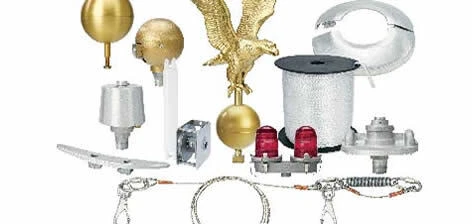
A flagpole looks simple: a tall pole with a flag on it. But a dozen small parts are working together to keep the flag flying, and when one of them wears out, the flag gets stuck, the rope snaps, or the pole starts banging all night. Here's every part of a flagpole from top to bottom, what it does, and what to look for when it's time for a replacement.
At the top of the pole
Ornament (finial). The ball, eagle or other topper at the very top. It's mostly decorative, but it also caps the truck and keeps water out. Gold-anodized aluminum balls are the most common.
Truck. The truck assembly sits under the ornament and holds the pulley your rope or cable runs over. There are two main types:
- External halyard trucks, for poles where the rope runs down the outside.
- Internal halyard trucks, for poles where the rope or cable runs inside the pole. These come in versions for rope or wire-cable systems.
Many trucks are revolving, meaning they spin with the wind so the flag doesn't wrap around the pole. If your flag keeps winding up, a seized truck is often the reason.
The halyard: rope or cable
The halyard is what raises and lowers the flag.
- Halyard rope is braided polyester or nylon. It's the most common on residential and external halyard poles. Texas sun breaks it down over time, so it's one of the most-replaced parts.
- Cable assemblies use stainless steel wire rope on internal halyard poles. They're stronger and more secure, and you'll find them on commercial and taller poles.
Attaching the flag
- Snap hooks clip the flag's grommets to the halyard. Swivel snaps let the flag turn freely and help prevent wrapping. Many come with vinyl covers so they don't clang against the pole.
- Retainer rings loop around the pole and the rope to keep the halyard from slapping against the pole in the wind. They're inexpensive and stop most of that annoying clanging at night.
- Counterweights are used on internal cable systems. They hang inside the pole and keep the cable taut when the flag is down.
At the bottom of the pole
- Cleats are where you tie off the rope on an external halyard pole. Cast aluminum cleats are the standard.
- Winches and crank handles raise and lower the flag on internal cable poles. The winch sits behind a locking access door, so no one can take your flag or cut the rope.
- Flash collars are the decorative ring at the base where the pole meets the ground or concrete. They cover the gap and keep water out of the foundation.
- Installation hardware, like ground sleeves and foundation hardware, sits below ground and holds the pole plumb and secure.
Lighting
If you fly your flag at night, it needs to be lit. A flagpole light, either a solar unit at the top of the pole or a spotlight at the base, keeps you within the U.S. Flag Code. Our flag etiquette guide covers the rest of the rules.
Signs a part needs replacing
- The flag is stuck halfway up, usually from a jammed truck pulley or a frayed rope.
- The rope is faded, fuzzy or stiff. Replace it before it snaps.
- The flag keeps wrapping around the pole, often from a seized revolving truck or missing swivel snaps.
- Constant clanging at night. Add retainer rings or snap covers.
- The winch slips or is hard to crank on an internal halyard pole.
- The ornament is missing or loose.
Ordering the right replacement
Most parts are sized to your pole. Before ordering, have these ready:
- The pole's top diameter, for trucks and ornaments. Measure the outside diameter at the very top.
- The pole's height, to know how much rope or cable you need. Halyard rope is usually about twice the pole height.
- External or internal halyard: does the rope run outside the pole or inside it?
- The brand, if you know it. For Concord poles, see our guide to Concord American flagpole parts.
Not sure what you have? Send us a photo of the top and bottom of your pole and we'll identify the parts for you.
Want us to handle it?
Many repairs, like replacing a truck or re-roping a tall pole, need a lift. Ameritex Flag & Flagpole is veteran-owned and has been servicing flagpoles since 2007. We do flagpole repair across San Antonio and the Texas Hill Country, or you can shop all flagpole parts and do it yourself.